
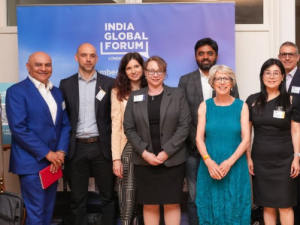
IGF London 2025 brought together influential leaders, policymakers, and innovators to explore how the recently announced deal between the UK and India can unlock the next decade of collaboration. From digital trade, sustainable finance, frontier tech and regulation for inclusive growth, to ways to implement mutually beneficial programmes.
BIVDA took part in discussions in the UK-India Future Frontiers Forum at the Science Museum which examined transformative technologies, AI, and healthtech.
The objectives of the forum match BIVDA’s work to support economic growth and provide members with strategic insight into the UK-India trade relationship. It was extremely useful to better understand how the two countries are leveraging trust, scale, and shared values to drive global change, explore opportunities, look at the next generation of innovations, meet with government officials and develop connections for the sector.
Speakers at the event included current Cabinet Ministers Jonathan Reynolds, Lisa Nandy, Science Minister Lord Vallance, and former PM Rishi Sunak.
Helen took part in a roundtable discussion on charting Global Health preparedness.
The recent UK–India Memorandum of Understanding on Life Sciences is a strategic pivot towards transformative healthcare collaboration, combining India’s frugal innovation at scale with the UK’s sophisticated clinical ecosystem. With the UK–India Free Trade Agreement also referencing closer cooperation on health, the potential tangible benefits of this partnership for both nations were discussed, including how the UK and India can ensure that innovation doesn’t just stay on trial phases but translates into accessible and cost-efficient real-world solutions.
During the roundtable, chaired by Rt Hon Dame Patricia Hewitt, Helen outlined the opportunities and challenges for BIVDA members. She highlighted the need to diagnose sooner, and closer to patients, and underlined how critical it is for a full understanding of patient need and risk proportionality to be considered. Detail in regulation is required to reduce complexity, and she emphasised that the UK and India need to decide what is needed and how we want to use that technology as that will determine what the framework needs to look like for regulation.
There has been progress with a more national approach to regulation, evaluation and procurement for companies wanting to sell into India as part of the agreement. Helen stressed the need for India to align with IMDRF, ISO and international programmes to truly capture the opportunities for diagnostic innovation.
Other participants in this roundtable included David Lawson (DHSC), Andrew Wheeler (NICE), Bassam Hallis (UKHSA), Suzanne Fuller (MHRA), Mark Samuels from Medicines UK and Malcolm Evans from BIVDA member company Oxford Nanopore, to name a few.
